Balancing Whole-Home Dehumidifiers with Your Existing AC for Optimal Comfort
Balancing Whole-Home Dehumidifiers with Your Existing AC for Optimal Comfort
Myth: Your Air Conditioner Is All You Need for Summer Humidity
A common misconception among homeowners is that cooling the air and drying the air are the exact same process. In reality, balancing whole-home dehumidifiers with your existing AC for optimal comfort is often the missing piece to a truly comfortable home. Most people believe that simply dropping the temperature on the thermostat will eventually strip all the sticky moisture out of the air. While an air conditioner does remove some humidity as it runs, it is primarily designed to lower the temperature, not manage moisture.
As we approach the late August and back-to-school transition, our team at Allied Plumbing Heating & Cooling sees this myth become a highly noticeable problem across Springfield. The intense heat of mid-summer starts to break, but the muggy, sticky indoor air remains. You are left with a frustrating decision: keep dropping the thermostat and freezing out your family just to force the Air Conditioning to run, or find a better way to extract the moisture. Rather than relying on an oversized AC that runs constantly and inefficiently, integrating dedicated indoor air quality solutions allows you to separate temperature control from moisture control, giving you a perfectly balanced indoor environment.
The Mechanics of Comfort: Sensible vs. Latent Heat
To understand why a house can feel terrible even when the thermostat says 70 degrees, you have to look at how heating and cooling professionals measure heat. There are two distinct types of heat in your home: sensible heat and latent heat. Your air conditioner handles these two elements very differently.
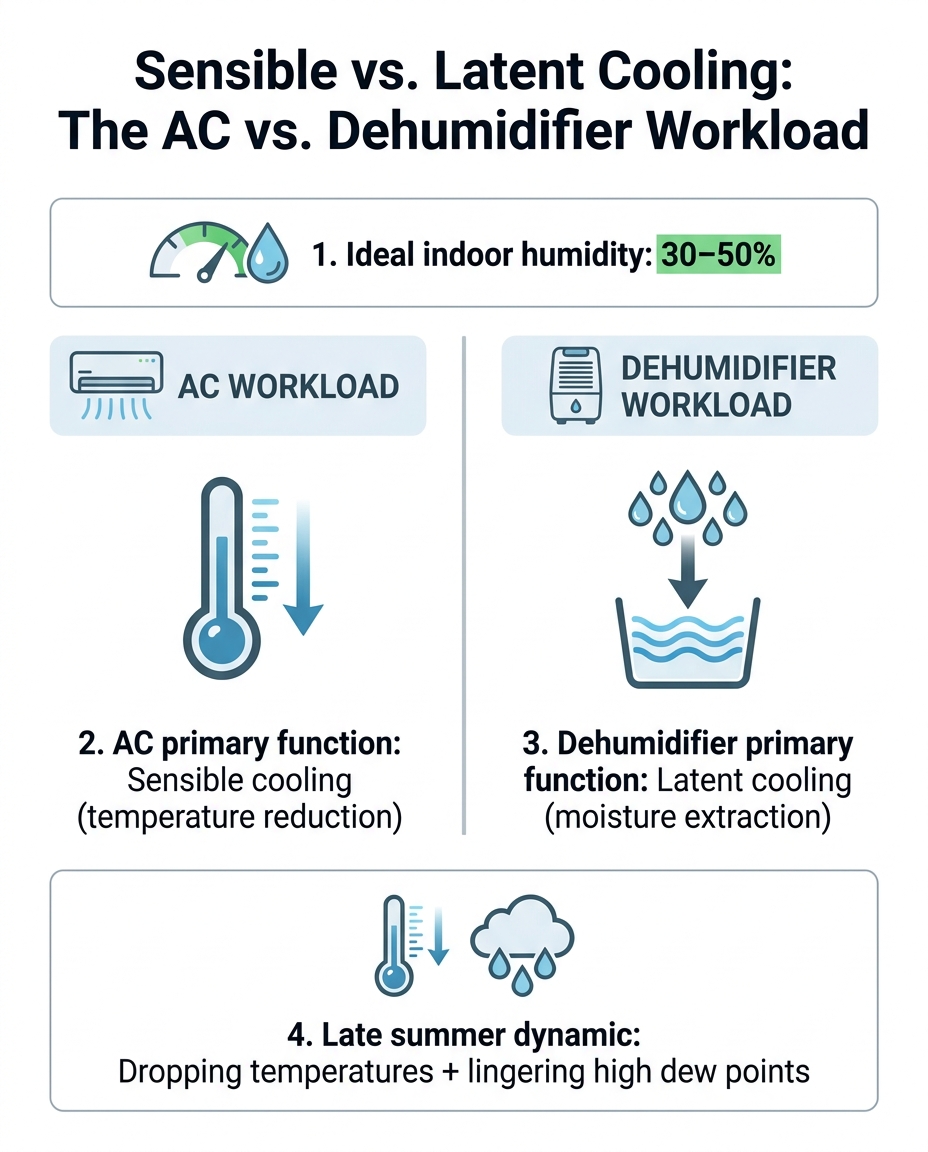
Sensible cooling refers to the actual drop in temperature that a thermometer can measure. When your AC kicks on and blows 55-degree air into a 75-degree room, it is actively removing sensible heat. Latent cooling, on the other hand, is the extraction of moisture from the air. When warm, humid air passes over the freezing cold evaporator coil in your ductwork, water vapor condenses into liquid and drains away. This is latent cooling in action.
The issue our technicians frequently encounter is that standard air conditioners perform latent cooling strictly as a byproduct of sensible cooling. They are not optimized for moisture removal; they just happen to remove water while they lower the temperature. According to the Environmental Protection Agency (EPA), keeping indoor relative humidity between 30% and 50% is highly recommended for optimal health, comfort, and the prevention of mold growth. When an AC is forced to handle all the latent heat on its own, it rarely hits that ideal 30-50% window during humid weather.
Why Thermostats Only Tell Half the Story
Your standard wall thermostat is essentially blind to moisture. It only reads sensible heat. You might set the dial to 72 degrees, and the AC will shut off the exact moment the room hits 72 degrees. However, if the relative humidity in the room is still hovering at 65%, your body cannot evaporate sweat efficiently. The result is a high indoor relative humidity (clammy feeling) that makes 72 degrees feel sticky, heavy, and deeply uncomfortable. The thermostat thinks its job is done, but your body knows the air is still holding too much water.
Why Your AC Struggles During the Late-Summer Transition
The limitations of an AC-only approach become glaringly obvious during specific seasonal shifts. In our decades of servicing Springfield and the surrounding Midwest, we see a very distinct late-summer transition. As August rolls on, the extreme 95-degree heat waves often begin to break, and ambient outdoor temperatures might drop into the low 80s or high 70s. However, the dew points remain exceptionally high. The air outside is thick, heavy, and loaded with water vapor.
Because the outdoor temperature is relatively mild, your home does not heat up as quickly during the day. Your thermostat doesn't sense a rapid rise in sensible heat, so it doesn't tell the air conditioning services equipment to turn on very often. When the AC does kick on, it cools the house down to the target temperature very quickly and immediately shuts back off. The system simply doesn't run long enough to pull the heavy moisture out of the air.
Sometimes, homeowners hesitate to add dedicated moisture-control equipment because they've been told their current setup won't accommodate it. One local customer reached out to us after another company explicitly stated that installing a new indoor air quality unit on their existing system could not be done. Our Allied technicians evaluated the setup, successfully installed the unit on that very system, and even adjusted the final invoice to reflect the true scope of work, proving that proper retrofitting is entirely achievable when you work with the right team.
The Short-Cycling Dilemma
When an oversized air conditioner cools a home too quickly, it results in a phenomenon known as short-cycling. A system that runs for only 8 to 10 minutes will satisfy the thermostat, but shorter run times mean drastically less air passes over the indoor evaporator coil. The moisture stays trapped indoors. Furthermore, the massive amount of condensation that does manage to form in those brief bursts places a heavy burden on your AC drain lines, often leading to clogs and backups when the system tries to manage massive moisture loads alone.
The "Cold and Clammy" Effect: The Hidden Cost of AC-Only Control
When your air conditioner is the only tool you have to fight humidity, you are forced into a frustrating corner. A pattern we see often is homeowners reacting to high humidity by walking over to the thermostat and cranking the temperature down to 68 or 67 degrees. They don't actually want the house to be 68 degrees; they just want the AC to turn back on so it will wring some moisture out of the air.
This creates the dreaded "cold and clammy" effect. The house feels like a damp cave. You might find yourself wearing a sweater indoors in the middle of August just to tolerate the over-cooled air. Beyond the physical discomfort, relying entirely on your AC for dehumidification carries several hidden costs:
1. Massive Energy Waste: Running an AC at 68 degrees demands significantly more electricity than running it at 74 degrees. You are paying a premium to overcool your home just to chase away the humidity. With proper dedicated dehumidification, most families find that 74 or even 76 degrees feels perfectly comfortable.
2. Accelerated System Wear and Tear: Forcing your compressor to start and stop constantly (short-cycling) or run continuously at extreme low settings puts immense mechanical strain on the equipment, potentially shortening the lifespan of your cooling system.
3. Amplified Indoor Odors: Excess moisture trapped indoors creates a breeding ground for musty smells. Damp air holds onto particulates much longer than dry air. In fact, learning how high summer humidity amplifies indoor VOCs and odors is a major wake-up call for families dealing with lingering smells in their carpets and upholstery.
4. Risk of Frozen Coils: Pushing an air conditioner to run constantly at very low temperatures to fight humidity can cause the evaporator coil to literally freeze into a block of ice, shutting down your cooling entirely.
How a Dedicated Whole-Home Dehumidifier Solves the Puzzle
The most effective way to eliminate a high indoor relative humidity (clammy feeling) without turning your living room into a refrigerator is to install a dedicated whole-home dehumidifier. Unlike portable units that you have to empty manually and drag from room to room, a whole-home system integrates directly into your existing forced-air ductwork.
When you add one of these units to your HVAC products in Springfield, we typically see a fundamental change in how your home manages comfort. The dehumidifier sits next to your furnace or air handler. As air is pulled from the house through the return ducts, it passes through the dehumidifier first. The unit extracts the excess water vapor, drains it directly into your plumbing system, and then sends the dry air either into the AC coil for cooling or straight back into the house.
Independent Moisture Removal
The greatest advantage of a whole-home dehumidifier is its ability to run completely independently of your cooling cycle. It operates via a dedicated humidistat (or a smart thermostat with humidity controls). If sensors detect that the humidity has risen above your target of 45%, the dehumidifier activates and gently circulates dry air throughout the entire house—even if the main air conditioner is turned off. This allows you to raise your thermostat settings significantly while feeling much more comfortable, and it completely protects the lifespan of your primary AC unit by drastically reducing its workload.
Side-by-Side Comparison: AC-Only vs. AC + Whole-Home Dehumidifier
To truly understand the value of separating your sensible and latent cooling workloads, it helps to look at the two approaches side by side. Relying on an AC alone is a reactive approach to moisture, while adding a dehumidifier provides proactive, targeted control.
• Moisture Removal Trigger — AC-Only Approach: Only removes humidity when the thermostat calls for a drop in temperature. — AC + Whole-Home Dehumidifier: Activates automatically whenever humidity rises above the target percentage.
• Energy Efficiency — AC-Only Approach: Low. Requires overcooling the home to 68°F or lower just to feel dry. — AC + Whole-Home Dehumidifier: High. Allows you to set the thermostat to 74°F-76°F while maintaining comfort.
• Comfort Consistency — AC-Only Approach: Temperature swings; often results in a cold, clammy, or damp feeling. — AC + Whole-Home Dehumidifier: Steady, crisp air. Eliminates sticky skin and heavy, muggy air entirely.
• System Wear and Tear — AC-Only Approach: High strain. Prone to short-cycling and heavy condensation line burdens. — AC + Whole-Home Dehumidifier: Distributed workload. Extends the life of the AC compressor and coils.
• Late-Summer Effectiveness — AC-Only Approach: Struggles heavily when outdoor temperatures drop but dew points stay high. — AC + Whole-Home Dehumidifier: Excels. Removes moisture even on mild days when the AC isn't running at all.
Sensible vs. Latent Cooling: The AC vs. Dehumidifier Workload
Making the Right Choice for Your Midwest Home
Achieving optimal comfort requires a delicate balance of sensible and latent cooling. In our specific region, this balance is constantly tested. Springfield IL and surrounding Midwest homes face unique environmental challenges, particularly due to regional agricultural evapotranspiration. Often referred to locally as "corn sweat," the massive agricultural footprint in the Midwest releases millions of gallons of water vapor into the atmosphere during late summer. This causes local humidity levels to spike drastically, even when the thermometer reads a mild 78 degrees.
As a multi-generational, family-owned business, the team at Allied Plumbing Heating & Cooling has spent decades helping local families navigate these exact seasonal shifts. We know firsthand how Springfield homes have historically handled—or struggled to handle—these late-summer humidity spikes. In our experience, an off-the-shelf air conditioner sized purely for peak July heat is almost guaranteed to short-cycle and fail at moisture removal during the late August back-to-school transition.
That is why having your system properly evaluated and sized by local professionals who understand these specific weather patterns is so important. A whole-home dehumidifier is not just an accessory; for many Midwest homes, we consider it the only mechanical way to truly neutralize the heavy, damp air that settles into our region every year.
Find Your Perfect Balance of Cooling and Humidity Control
You do not have to settle for a cold and clammy house, and you certainly don't have to wear a sweater indoors in August just to keep the humidity at bay. By integrating the right equipment, you can enjoy a home that feels crisp, clean, and perfectly balanced.
If you are tired of fighting the thermostat and want to solve your home's moisture problems for good, it is time to talk to an expert about your specific situation. Explore our indoor air quality solutions today to find the perfect balance of cooling and humidity control for your family.
Frequently Asked Questions
Why is my house humid even when the AC is running? The short answer is that your air conditioner might be short-cycling or oversized. If the AC cools the air too quickly, it shuts off before it has time to extract the lingering moisture. This leaves you with cool but heavy, damp air.
How does a whole-home dehumidifier work with existing HVAC? A whole-home dehumidifier is installed directly into your existing ductwork, usually near the furnace or air handler. It pulls air from the return ducts, removes the moisture, and sends the dry air back into circulation. It operates using its own sensors, meaning it works seamlessly alongside your current setup.
Can you run a dehumidifier and AC at the same time? Yes, they are designed to work together perfectly. While the AC focuses on dropping the sensible temperature, the dehumidifier focuses on extracting the latent heat (moisture). Running them simultaneously provides the fastest relief on extremely muggy days.
Does a dehumidifier help an AC cool better? Absolutely. Dry air feels significantly cooler on your skin than damp air because your body can evaporate sweat normally. By removing the humidity, a dehumidifier allows your AC to reach a comfortable state much faster and lets you set the thermostat several degrees higher without losing comfort.
What is the ideal indoor humidity level for a Midwest home in August? The EPA recommends keeping your indoor relative humidity between 30% and 50%. In the peak of a Midwest August, aiming for around 45% strikes the perfect balance between comfort, energy efficiency, and preventing indoor mold growth.
Will adding a whole-home dehumidifier reduce my cooling bills? In many cases, yes. Because dry air feels cooler, most homeowners find they can raise their thermostat from 68 degrees up to 74 or 76 degrees. The energy saved by running the heavy-duty AC compressor less frequently often offsets the small amount of electricity used by the highly efficient dehumidifier.
The Role of the Draft Inducer Motor in Safely Starting Your Gas Furnace
October 12, 2026
When you turn on your heater for the first fall chill, that initial 60-second humming isn't a malfunction. It's the pre-purge cycle clearing residual gases to protect your home.
When you turn on your heater for the first fall chill, that initial 60-second humming isn't a malfunction. It's the pre-purge cycle clearing residual gases to protect your home.
Identifying Older Galvanized Pipes in Historic Chatham Homes Before Winter Hits
October 10, 2026
Freezing temperatures put immense stress on pre-1960s plumbing. Spotting hidden internal corrosion early helps you decide if a drop in water pressure warrants a professional inspection.
Freezing temperatures put immense stress on pre-1960s plumbing. Spotting hidden internal corrosion early helps you decide if a drop in water pressure warrants a professional inspection.
Standard vs Modulating Gas Valves for Consistent Heating in Two-Story Homes
October 9, 2026
Extreme temperature differences between floors often come down to your furnace's gas valve. See how a modulating system balances airflow to eliminate hot and cold zones.
Extreme temperature differences between floors often come down to your furnace's gas valve. See how a modulating system balances airflow to eliminate hot and cold zones.