When the Cost of AC Repair Exceeds the Value of Your System in Springfield
When the cost of AC repair exceeds the value of your system, it's usually time to stop putting money into the old unit and start planning for a replacement. Here's a quick-reference guide to help you decide:
The repair cost crosses the line when:
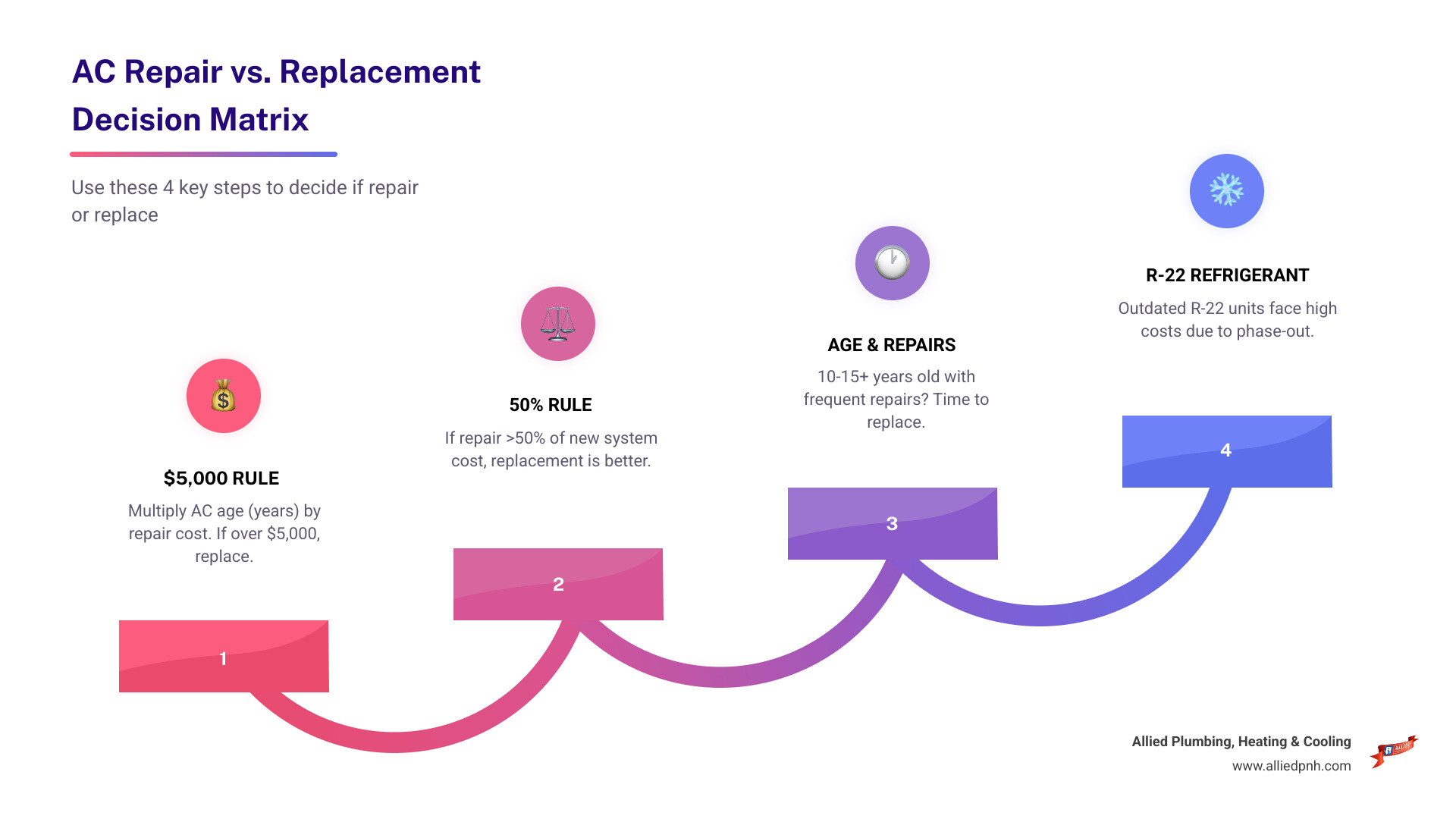
• The $5,000 Rule is triggered: your AC's age (in years) multiplied by the repair cost is greater than $5,000
• The repair quote is more than 50% of what a new system would cost
• Your unit is 10-15 years old and has needed multiple repairs in the past year or two
• The system uses R-22 refrigerant, which is no longer produced and now very expensive to source
• Energy bills have climbed noticeably higher without any change in how you use the AC
If any of these apply to your situation in Springfield — especially more than one — replacement is almost always the smarter financial move.
It's the middle of summer in Springfield. Your AC stops working. A technician shows up, gives you a repair estimate, and now you're staring at a number that makes your stomach drop. Do you pay it? Or is this the moment you finally replace the system?
This is one of the most stressful decisions a homeowner can face — and most people make it under pressure, without a clear framework. The truth is, there's a point where repairing an aging AC unit stops making financial sense. You end up pouring money into a system that's already near the end of its useful life, only to face the next breakdown a few months later.
This guide walks you through exactly how to evaluate that decision — using simple rules, real cost comparisons, and a few key warning signs — so you can stop guessing and start acting with confidence.
Applying the $5,000 Rule to Your Cooling System
When we visit homes in Springfield to diagnose a cooling issue, one of the first things we look at isn't actually the broken part—it’s the silver nameplate on the side of the outdoor unit. This little sticker tells us the manufacture date. Why does that matter? Because age is the ultimate "multiplier" for your repair costs.
In the HVAC world, we use a simple mathematical framework called the $5,000 Rule. It’s a quick gut-check to see if a repair is a sound investment or just throwing good money after bad. To use it, you simply multiply the age of your system (in years) by the estimate for the current repair. If the total is over $5,000, the math says it’s time to replace.
Let’s look at two scenarios we see often in our local area:
1. The "Repairable" Scenario: You have a 5-year-old unit that needs a new capacitor. Even if it’s a standard mid-range repair, 5 years multiplied by that cost is going to be well under $5,000. In this case, your system still has plenty of life left, and the repair is worth it.
2. The "Money Pit" Scenario: You have a 12-year-old unit that needs a major component, like a fan motor or a significant leak fix. If you multiply 12 by that repair quote and the result is $6,000 or $7,000, you are officially in "replacement territory."
Why $5,000? It’s the industry-standard tiebreaker because it accounts for the remaining useful life of the equipment. An AC unit in Springfield typically lasts between 12 and 15 years. If you’re at year 12, you’re already in the "fourth quarter" of the system's life. Spending a large amount of money now doesn't reset the clock on the rest of the aging components. It just keeps a 12-year-old machine limping along for another season or two.
We often tell our neighbors in Springfield that frequent repairs are like a "warning shot." If you’ve had two or more unscheduled repairs in the last 24 months, the $5,000 Rule becomes even more critical. You can learn more about these indicators in our guide on Signs It's Time for an AC Replacement.
When the cost of ac repair exceeds the value of your system: The 50% Rule
While the $5,000 Rule is great for a quick calculation, the 50% Rule is about asset valuation. Think of your AC like a car. If your 2012 sedan needs a new transmission that costs more than half of the car's total blue-book value, you’d probably trade it in rather than fix it. Your cooling system works the same way.
When the cost of a single repair exceeds 50% of the price of a brand-new, high-efficiency system, you have reached a major economic threshold. This is especially true for major component failures, such as:
• A failed compressor: Often called the "heart" of the system.
• A leaking evaporator coil: Which requires both the part and a significant amount of refrigerant.
• A cracked heat exchanger: (In the case of a packaged HVAC unit).
• 1–8 Years — Repair Cost % of New System: Less than 50% — Recommendation: Repair (Usually under warranty)
• 8–12 Years — Repair Cost % of New System: 25% – 50% — Recommendation: The "Gray Zone" (Evaluate efficiency)
• 10+ Years — Repair Cost % of New System: Exceeds 50% — Recommendation: Replace (High risk of future failure)
In the "Gray Zone," we have to look at the root cause of the failure. If the failure was caused by a lack of maintenance or a systemic issue (like poor ductwork), simply replacing the part won't fix the underlying problem. If you’re unsure what’s going on with your unit, check out our tips on How to Identify When Your AC Needs Repair.
We find that homeowners who choose to replace once they hit that 50% threshold end up much happier in the long run. Not only do they avoid the "repair spiral"—where one fix leads to another—but they also gain the peace of mind that comes with a fresh manufacturer warranty. At Allied Plumbing, Heating & Cooling, we take that peace of mind a step further with the Daikin Comfort Promise and 12-year warranties on select systems, ensuring you won't be back in this dilemma for a long, long time.
Red Flags That Signal an Economical End-of-Life
Sometimes, the decision isn't just about a single big repair bill. Sometimes, it’s a "death by a thousand cuts." There are specific red flags that signal your system has reached its economical end-of-life, regardless of what the current repair quote says.
In Chatham, we deal with significant humidity during the peak of summer. If your AC is struggling to pull moisture out of the air, your home will feel "sticky" even if the temperature is technically hitting the thermostat setting. This is a sign that the system is losing its capacity.
Other red flags include:
• Short Cycling: The unit turns on and off every few minutes. This puts immense strain on the electrical components and the compressor.
• Uneven Temperatures: One bedroom is a freezer while the living room is a sauna. This often points to a blower motor that’s failing or a system that can no longer move air effectively.
• Strange Noises: Grinding, squealing, or heavy banging sounds usually mean a major mechanical failure is imminent.
If you’re noticing these symptoms, you’re likely seeing Signs Your Old AC Unit Needs Replacement. It’s better to make the call now, on your own terms, rather than waiting for the unit to have a "terminal" breakdown on a 95-degree Sunday afternoon.
Why when the cost of ac repair exceeds the value of your system matters for R-22 units
If your AC was installed before 2010, there is a very high chance it uses R-22 refrigerant (often called Freon). This is a major factor in determining when the cost of ac repair exceeds the value of your system.
As of 2020, R-22 is no longer produced or imported in the United States due to environmental regulations. Because the supply is strictly limited to what has been "reclaimed" from old units, the price has skyrocketed. In May 2026, finding R-22 is not just expensive; it’s becoming a logistical challenge.
If your old R-22 unit has a refrigerant leak, you are facing a "double whammy":
1. You have to pay to find and fix the leak (which is labor-intensive).
2. You have to pay for the incredibly expensive R-22 to refill the system.
In almost every case, we recommend against putting R-22 into a system that is 15+ years old. You are essentially paying a premium price to support an obsolete platform. When you consider AC replacement with experts, they will explain that modern refrigerants like R-454B are not only better for the planet but are also the new standard for the next decade of cooling technology.
Evaluating efficiency when the cost of ac repair exceeds the value of your system
Efficiency is the "hidden" part of the value equation. In Rochester, utility bills can climb quickly when you’re running an old SEER 10 or 12 unit. By today's standards (May 2026), those units are incredibly wasteful.
The current SEER2 standards have pushed entry-level efficiency much higher. A modern high-efficiency system can be 30% to 50% more efficient than a unit from 2012. This means that every month you keep the old unit, you are essentially paying a "tax" in the form of higher energy bills.
When we calculate when the cost of ac repair exceeds the value of your system, we have to factor in those operational savings. If a new system saves you a significant amount on your monthly Rochester utility bills, that "ROI" helps pay for the replacement. Over 5 to 7 years, the energy savings alone can often offset a large portion of the installation cost.
Long-Term Hidden Costs of Aging HVAC Units
The price tag on the repair estimate is never the full story. There are "hidden costs" to keeping an old system alive that homeowners often forget to calculate.
First, there’s the Emergency Service Fee. Systems don't usually break down on pleasant Tuesday mornings; they fail when they are under the most stress—which means the hottest days of the year, often on weekends or holidays. Emergency repairs come with higher labor rates and the stress of a hot house.
Second, there is the Cumulative Repair Spending. We call this the "Repair Spiral." You spend a few hundred dollars on a fan motor in June. In August, the contactor goes out. Next July, it’s a refrigerant recharge. Before you know it, you’ve spent half the cost of a new system in small increments, but you still have an old, unreliable unit.
Finally, there is Performance Degradation. As an AC ages, the coils get pitted, the motor loses RPMs, and the internal components simply don't work as well as they used to. Even if it's "running," it’s likely not providing the same level of comfort it did ten years ago. For a deeper dive into managing these aging systems, see our AC Repair Springfield Guide 2025.
Frequently Asked Questions
Is a 12-year-old AC unit worth repairing in Springfield?
It depends on the repair. If it's a simple electrical fix like a capacitor or a clogged condensate line, then yes, it’s worth a few hundred dollars to keep it going. However, if the repair involves the compressor or a major refrigerant leak, you are likely better off replacing it. At 12 years old, you are right at the edge of the typical lifespan for Springfield HVAC systems, and a major repair now is often followed by another failure shortly after.
What is the most expensive AC repair to avoid?
The compressor replacement is generally the most expensive repair. It involves high part costs, significant labor, and a full refrigerant charge. Because the compressor is the heart of the system, its failure often indicates that the rest of the system has been under significant stress. Putting a brand-new compressor into a 10-year-old system is rarely a good investment.
How do new warranties affect the repair vs. replace decision?
New warranties are a massive factor. When you repair an old unit, you usually only get a 90-day or 1-year warranty on that specific part. The rest of the machine remains unprotected. When you replace the system with us, you can take advantage of the Daikin Comfort Promise and 12-year warranties. This means you have a decade-plus of "cost certainty" where you won't have to worry about major repair bills.
Conclusion
At Allied Plumbing, Heating & Cooling, we’ve been a 3-generation family business since 1977. We’ve seen thousands of AC units across Springfield, Rochester, and Chatham, and we know that the decision to replace isn't just about the machine—it’s about your family’s comfort and your financial peace of mind.
We don't want you to keep pouring money into a "money pit." Our goal is to provide you with an honest assessment so you can make the best choice for your home. Whether that’s a professional repair to get you through the season or a transition to a new, high-efficiency system, we are here to help.
If you’re ready to stop the "repair spiral," we invite you to read our A Guide to New AC Installation or, better yet, schedule your professional system evaluation today. Let us help you crunch the numbers and find the most cost-effective path to a cool, comfortable home.