Knowing how to choose the right ac system for your home is the single most important step toward staying comfortable, keeping energy bills manageable, and avoiding costly breakdowns down the road. With roughly 90% of U.S. households relying on air conditioning, it's one of the biggest decisions a homeowner will make.
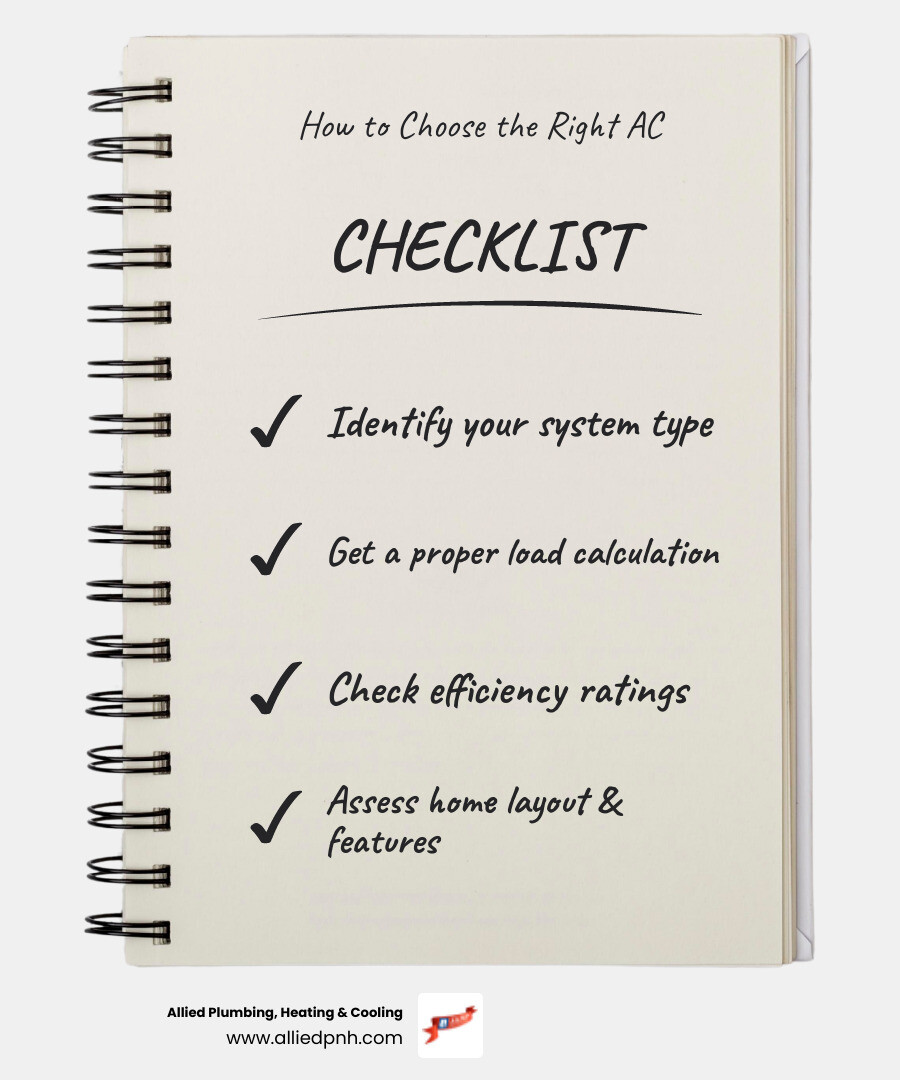
Here's a quick overview of how to choose the right AC system:
1. Identify your system type - Central AC, ductless mini-split, window unit, portable, or heat pump
2. Get a proper load calculation - A professional Manual J calculation determines the right size in BTUs or tons for your specific home
3. Check efficiency ratings - Look for SEER2 and EER2 ratings; higher numbers mean lower energy bills
4. Assess your home's layout - Consider ductwork condition, insulation quality, ceiling height, and window orientation
5. Look for modern features - Variable-speed compressors, smart thermostat compatibility, and quiet operation matter
6. Factor in long-term costs - A higher upfront cost on an efficient system often saves more over time
7. Hire a qualified installer - Proper installation is just as important as the unit itself
It sounds straightforward. But in practice, most homeowners run into the same frustrating traps: buying a unit that's too large, ignoring ductwork problems, or choosing based on price alone. The result? A system that short-cycles, leaves rooms feeling humid and uneven, and wears out faster than it should.
Air conditioning in an average-sized home uses more than 2,000 kilowatt-hours of electricity per year. That means a poor choice doesn't just hurt your comfort — it hits your wallet every single month.
This guide walks you through every factor that matters, so you can make a confident, informed decision.
Understanding the Main Types of AC Systems
When we talk about how to choose the right ac system for your home, the first hurdle is deciding which "delivery method" fits your lifestyle. Not every home in Springfield or Chatham is built the same; a historic home in Rochester might have different needs than a new build in Sherman.
Central Air Conditioning
This is the most common choice for whole-home cooling. It uses a network of supply and return ducts to circulate chilled air. It’s ideal for larger homes where you want a consistent temperature in every room. However, if your home doesn't already have ductwork, installing it can be a significant undertaking.
Ductless Mini-Split Systems
If you have a room addition, a finished basement, or a home without existing ducts, Ductless AC Springfield IL is a fantastic alternative. These systems consist of an outdoor unit connected to one or more indoor air handlers mounted on the wall. They allow for "zoning," meaning you can cool the living room while keeping the guest room at a different temperature, saving energy in the process.
Window and Portable Units
These are generally "spot coolers." While they have a lower initial cost, they are often noisy, less efficient, and can only handle a single room. For a permanent, efficient solution, we usually recommend moving toward a more robust system.
Split Systems vs. Packaged Units
Most central systems are "split systems." This means you have an indoor evaporator coil (often sitting on top of your furnace) and an outdoor condenser unit. A "packaged unit," on the other hand, contains all components—compressor, condenser, and evaporator—in one single cabinet, usually placed on the roof or a concrete slab next to the house. Packaged units are common in homes with limited indoor space for an air handler.
The Versatility of Heat Pumps
Don't let the name fool you; heat pumps are world-class cooling machines. In the summer, they work exactly like an air conditioner, pulling heat out of your home and dumping it outside. In the winter, they reverse the process. Because they move heat rather than generate it through combustion, they are incredibly sustainable. For many families, Air Conditioning Springfield IL is transitioning toward heat pump technology because of the dual-season benefits and high efficiency.
How to Choose the Right AC System for Your Home Based on Size
One of the biggest mistakes we see is the "bigger is better" mentality. If an AC unit is too large for your home, it will "short cycle"—turning on and off rapidly. This prevents the system from properly dehumidifying the air, leaving you with a home that feels cold but clammy. Conversely, a unit that is too small will run constantly, skyrocketing your energy bills and wearing out the components prematurely.
Calculating BTUs for Your Space
Cooling capacity is measured in British Thermal Units (BTUs). A "ton" of air conditioning equals 12,000 BTUs per hour. As a very rough rule of thumb, a 2-ton unit might cool a 1,200 sq. ft. home, while a 5-ton unit could handle 3,000 sq. ft. However, square footage is only the beginning.
When we perform an AC Installation Springfield IL, we look at:
• Ceiling Height: High vaulted ceilings mean more air volume to cool.
• Window Orientation: Large south-facing windows act like giant heaters in the afternoon.
• Insulation Quality: How well does your home hold onto the cold air?
• Local Climate: Our Illinois summers can be both hot and incredibly humid.
Why Professional Sizing Matters for Your Home
To get the size exactly right, we use the industry-standard Manual J load calculation. This isn't a guess; it's a scientific assessment of your home’s "heat gain." A professional calculation ensures your system is perfectly balanced to maintain a steady temperature and, more importantly, manage humidity levels. Proper sizing is the foundation of energy efficiency and system longevity.
Decoding Efficiency Ratings: SEER2, EER2, and ENERGY STAR
Efficiency ratings can look like alphabet soup, but they are vital for understanding your long-term operating costs. In 2023, the industry moved to "M1" testing standards, which is why you now see a "2" at the end of many ratings.
• SEER2 — What it Measures: Seasonal Energy Efficiency Ratio — Why it Matters: Measures efficiency over an entire cooling season. Higher is better.
• EER2 — What it Measures: Energy Efficiency Ratio — Why it Matters: Measures efficiency at a specific high temperature (usually 95°F).
• ENERGY STAR — What it Measures: Government Certification — Why it Matters: Units that are at least 15% more efficient than standard models.
The Benefits of High SEER2 Ratings
While the minimum allowable SEER2 in the North is 13.4, modern high-efficiency systems can reach ratings as high as 26. Choosing a high SEER2 unit is an investment. While the initial equipment might be more advanced, the reduction in monthly utility bills can be substantial. Furthermore, high-efficiency units often utilize variable-speed technology, which allows the system to adjust its output precisely rather than just being "100% on" or "off."
Looking for the ENERGY STAR Label
We always encourage homeowners to look for the ENERGY STAR label. These units have undergone rigorous performance testing to ensure they meet strict efficiency standards. Beyond the energy savings, many utility companies offer rebates for AC Maintenance Springfield IL or new installations of ENERGY STAR certified equipment.
Key Features and Modern Technology
The air conditioners of today are a far cry from the loud, rattling boxes of twenty years ago. When considering how to choose the right ac system for your home, these features can drastically improve your quality of life.
Variable-Speed Compressors and Inverters
Traditional ACs are like a light switch—they are either on or off. Variable-speed (or inverter) technology is more like a dimmer switch. The system can run at 30% capacity on a mild day or 100% on a scorching July afternoon. This leads to much more consistent temperatures (within 0.5 degrees) and superior humidity management.
Smart Thermostats and System Integration
A smart thermostat is the "brain" of your cooling system. With Wi-Fi connectivity, you can adjust the temperature from your phone while you're at the grocery store in Chatham or at work in Springfield. These devices track your energy usage and can even alert you when it's time for an AC Service Springfield IL.
Noise Levels
If your outdoor unit is located near a bedroom window or a patio, noise matters. Sound levels are measured in decibels (dB). A standard AC might run at 72-76 dB, while a high-end, quiet model with sound blankets and specialized fan blades can operate at less than 60 dB—about the volume of a normal conversation.
When to Opt for an AC Replacement Over a Repair
It’s the age-old question: do I fix it one more time, or is it time to start fresh? If your system is between 10 and 15 years old, you are likely approaching the "replacement zone."
Evaluating Performance Issues
You should check out our guide on Signs It's Time for an AC Replacement if you notice:
• Rising Utility Bills: If your bills are climbing but your habits haven't changed, the system is losing efficiency.
• Frequent Breakdowns: If we’re visiting your home in Pleasant Plains or Glenarm every few months for a new repair, those costs add up quickly.
• R-22 Refrigerant: If your unit uses the old "Freon" (R-22), repairs become incredibly expensive because that refrigerant is no longer being produced.
Planning for a New Installation
If you are planning home renovations, such as adding a sunroom or finishing an attic, your current AC may no longer be able to keep up. This is the perfect time to evaluate AC Replacement Springfield IL. We also take this opportunity to inspect your ductwork integrity. Leaky or uninsulated ducts can waste 20% to 30% of your energy. Sealing those ducts ensures your new, efficient AC actually delivers the cold air to your living space.
The Importance of Professional Installation and Maintenance
You can buy the most expensive, high-tech AC unit in the world, but if it is installed poorly, it will never perform as advertised. Proper installation involves more than just "hooking it up." It requires verifying refrigerant charge levels, ensuring the correct airflow rate, and placing the thermostat in an optimal location away from heat sources.
Annual Maintenance Strategies
To protect your investment, we recommend a "set it and forget it" approach to maintenance.
1. Filter Changes: Check your filters monthly and change them at least every 90 days.
2. Coil Cleaning: Dirt on the outdoor coils forces the compressor to work harder.
3. Professional Inspections: Once a year, have a technician perform a full AC Repair Springfield IL check-up to catch small issues before they become midnight emergencies.
Ensuring Proper Airflow
Airflow is the lifeblood of your AC. We check for "static pressure" in your ducts to ensure the blower motor isn't struggling. We also look at register placement—making sure your furniture isn't blocking the vents—to ensure every corner of your home stays cool.
Frequently Asked Questions about Choosing a Home AC
What is the difference between SEER and SEER2?
SEER2 is the new standard as of 2023. It uses a different testing procedure that better accounts for the "real world" resistance of ductwork. Generally, a SEER2 rating will be slightly lower numerically than an old SEER rating for the same unit, but it is a more accurate representation of how the unit will perform in your home.
How do I know if my ductwork is compatible with a new AC?
A professional HVAC technician should always inspect your ducts before a new installation. If your ducts are undersized for a modern, high-efficiency blower, or if they are full of leaks, they may need to be modified or sealed to prevent energy waste.
Can a heat pump completely replace my traditional central AC?
Absolutely. In fact, for many homes in our service area, a heat pump is an upgrade. It provides high-efficiency cooling in the summer and can handle much of the heating load in the winter. Some homeowners choose a "dual fuel" system, where a heat pump handles the cooling and mild-weather heating, and a gas furnace kicks in during the most extreme Illinois cold snaps.
Conclusion: Trust the Experts at Allied Plumbing, Heating & Cooling
Picking the right air conditioner doesn't have to be a stressful experience. At Allied Plumbing, Heating & Cooling, we’ve been a 3-generation family business serving our neighbors since 1977. Whether you are in Springfield, Chatham, Rochester, or any of our surrounding communities, we bring decades of expertise to every home.
We are proud to offer the Daikin Comfort Promise, which includes industry-leading 12-year warranties. This gives you the peace of mind that your investment is protected for over a decade. When you're ready to see how a modern, efficient system can transform your home comfort, we are here to help.
Ready to upgrade? Contact us today for expert Air Conditioning Springfield IL service and let us help you find the perfect fit for your family.