Why a Dripping Faucet Is More Than Just an Annoyance
Why your faucet drips and what it means for your plumbing is something every Springfield homeowner should understand — because that slow, steady drip is rarely just a minor inconvenience.
Here is a quick answer before we dive deeper:
Common reasons your faucet drips:
• Worn-out washers or O-rings that no longer seal properly
• A corroded or damaged valve seat
• A failing cartridge or ceramic disc
• Water pressure that is too high
• Loose or deteriorated internal components
What it means for your plumbing:
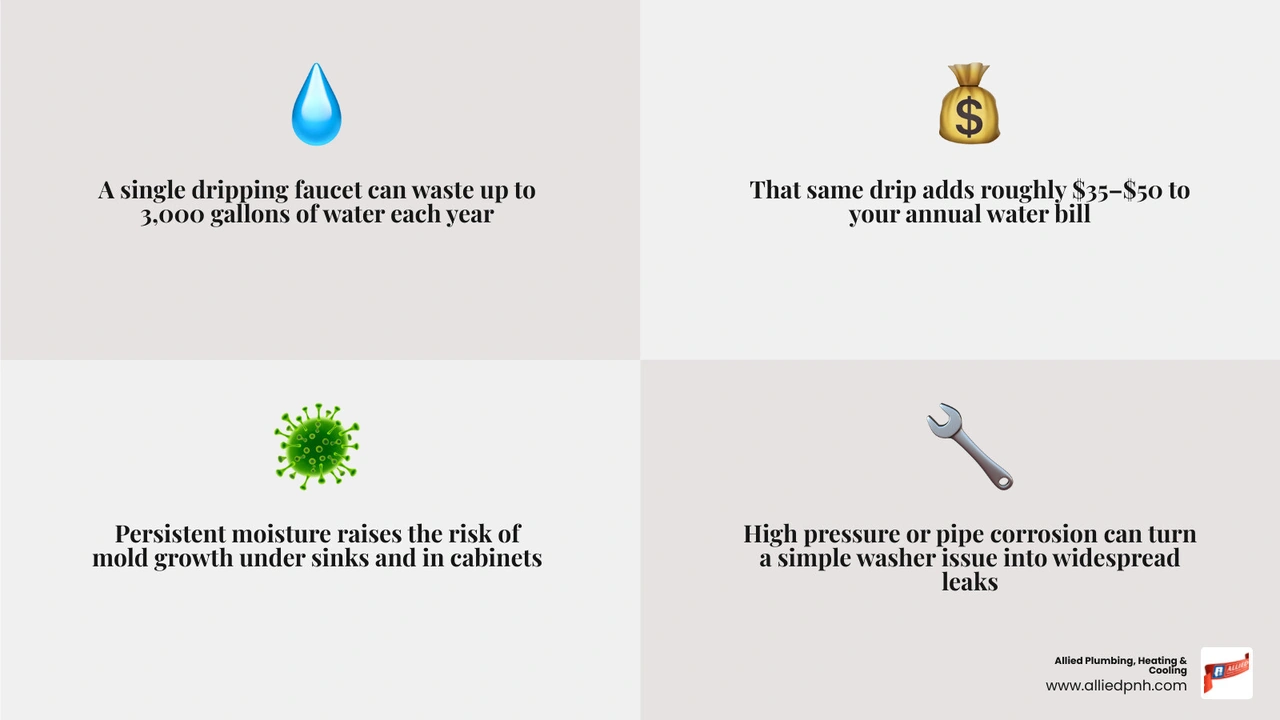
• Wasted water — up to 3,000 gallons per year from a single faucet dripping once per second
• Higher monthly water bills
• Risk of mold, water stains, and cabinet damage
• Possible sign of a larger systemic issue like high pressure or pipe corrosion
A properly working faucet should not drip at all when fully closed. If yours does, something inside needs attention.
Most people write off a dripping faucet as background noise. But household leaks waste nearly one trillion gallons of water each year across the U.S., and dripping faucets are one of the most common culprits. The average household wastes around 10,000 gallons of water per year from basic issues like these.
The good news? Most faucet drips come down to a small number of worn parts — and once you know what is causing the drip, fixing it is much more manageable than you might think.
In this guide, we will walk you through the most common causes, what they signal about your plumbing system, how to fix the problem yourself, and when it makes sense to call a professional.
Why Your Faucet Drips and What It Means for Your Plumbing

When we see a faucet dripping, it is tempting to think that the handle is just loose. Many of us try to solve the issue by tightening the handle as hard as possible. However, this is actually one of the worst things you can do. Overtightening puts extra stress on the internal seals, accelerating mechanical wear and worsening the leak.
To understand why a faucet drips, we have to look at how it works. When you turn the handle, you operate a valve that controls the flow of pressurized water. If the internal seals, washers, or cartridges that block this water fail, water slips through. Understanding Why Faucets Drip and Leak Over Time requires looking at three main factors: mechanical wear, water pressure, and mineral buildup. Over time, friction wears down rubber components, high pressure forces water past seals, and hard water minerals corrode the metal parts designed to keep your plumbing water-tight.
Understanding Why Your Faucet Drips and What It Means for Your Plumbing in Rochester
For homeowners in Rochester, local water quality plays a significant role in how fixtures wear out. Hard water contains dissolved minerals like calcium and magnesium. As water flows through your faucet, these minerals leave behind a crusty white or green residue known as limescale.
This mineral buildup acts like sandpaper on the soft rubber washers, O-rings, and gaskets inside your faucet. Every time you turn the faucet on and off, the rubber rubs against these rough mineral deposits, causing them to crack, stiffen, or tear. Once a washer is damaged, it can no longer form a tight seal, and water begins to drip from the spout. If the leak is coming from the base of the handle or the sink deck, a deteriorated O-ring is usually the culprit.
Ignoring these small drips can lead to bigger issues. Water pooling around the base of your faucet can seep under the sink deck and slowly rot your wooden cabinets. This is why it is crucial to stay alert for the Signs of Hidden Water Leaks before a minor drip turns into structural damage.
The Hidden Systemic Issues: Why Your Faucet Drips and What It Means for Your Plumbing in Chatham
In Chatham, a dripping faucet can sometimes point to systemic issues hidden deep within your home's infrastructure. If you replace the internal parts of a faucet and it continues to drip, or if multiple faucets in your home begin leaking at the same time, the root cause might be high water pressure.
Water pressure above 80 psi (pounds per square inch) is considered too high for residential plumbing. High water pressure acts as a "silent killer" for appliances and fixtures. It constantly forces water against internal seals, eventually overpowering them and causing leaks. High pressure can also lead to thermal expansion, where water expands as it heats up in your water heater, creating temporary pressure spikes that force faucet valves open.
Furthermore, a dripping faucet can be an early warning sign of internal pipe degradation. If you notice tiny black specks or rust-colored flakes in your water when you disassemble the faucet, it is highly likely that your pipes are deteriorating. Understanding How Pipe Corrosion Leads to Leaks and Low Pressure is essential, as corroded pipes shed metal debris that travels straight into your faucet cartridges, clogging the valves and preventing them from closing completely.
Different Faucet Types and Their Internal Components
Before you can fix a leak, you must know what kind of faucet you are dealing with. Residential faucets generally fall into one of four categories, each with its own unique internal design:
1. Compression Faucets: These are the oldest and most traditional style, typically recognizable by their separate hot and cold handles. They operate using a threaded screw mechanism that presses a rubber washer against a metal valve seat to stop water flow. Because they rely on constant physical pressure, compression washers wear out faster than parts in any other faucet type.
2. Cartridge Faucets: These can have one or two handles. Inside, a hollow metal or plastic cartridge moves up and down or rotates to regulate water flow and temperature. They are highly reliable, but the rubber seals on the cartridge itself can degrade or become clogged with sediment.
3. Ball Faucets: Most common in kitchen sinks, these single-handle faucets feature a rotating metal or plastic ball inside the body. The ball has slots that align with hot and cold water inlets. Because they contain several moving parts—including springs, small rubber seals, and O-rings—they are more prone to complex leaks.
4. Ceramic Disc Faucets: This is the most modern and durable option. They feature a single lever controlling two highly polished ceramic discs. As the lever moves, the discs slide against each other to block or allow water. Ceramic disc faucets have an incredibly low failure rate (under 5%), but they can still drip if hard water sediment gets trapped between the discs.
Here is a quick reference table comparing these faucet types and where they typically fail:
• Compression — Mechanism: Stem screw and rubber washer — Common Leak Location: Spout or handle base — Primary Cause of Drip: Worn rubber washer or corroded valve seat
• Cartridge — Mechanism: Rotating/sliding cartridge — Common Leak Location: Spout — Primary Cause of Drip: Failing cartridge seals or cracked cartridge body
• Ball — Mechanism: Rotating slotted ball — Common Leak Location: Handle base or spout — Primary Cause of Drip: Worn inlet seals, weak springs, or damaged O-rings
• Ceramic Disc — Mechanism: Two sliding ceramic plates — Common Leak Location: Spout — Primary Cause of Drip: Sediment buildup between discs or worn inlet seals
How to Stop That Dripping Faucet: A Step-by-Step DIY Guide
Ready to tackle that drip? Fortunately, learning How to Stop That Dripping Faucet is a straightforward process that most homeowners can complete in an afternoon.
Step 1: Prepare Your Workspace and Gather Your Tools
Before you do anything, make sure you have the following tools on hand:
• An adjustable wrench
• A flathead and Phillips-head screwdriver
• An Allen (hex) wrench (often 3/32-inch for handle set screws)
• Plumber's tape (Teflon tape)
• Replacement parts (O-rings, washers, or a new cartridge)
• White vinegar and a soft brush for cleaning
• A clean towel or sink stopper
Pro Tip: Always insert your sink stopper or lay a towel over the drain before you start. There is nothing more frustrating than watching a tiny screw bounce off the porcelain and slide down the drain!
Step 2: Shut Off the Water Supply
Never attempt to disassemble a faucet while the water lines are pressurized. Look under your sink for the hot and cold shutoff valves. Turn them clockwise until they are tight. Once closed, turn on the faucet handles completely to drain any remaining water and relieve pressure from the system.
Step 3: Remove the Faucet Handle
To access the internal valve, you must remove the handle.
• For double-handle compression faucets, use a flathead screwdriver to gently pry off the decorative plastic cap (often labeled "H" or "C"). Unscrew the screw underneath and pull the handle straight up.
• For single-handle faucets, look for a small set screw hidden under the handle curve or behind a small plastic plug. Loosen this screw with an Allen wrench, then wiggle the handle side-to-side while pulling upward to remove it.
Step 4: Extract the Stem or Cartridge
With the handle off, you will see the valve assembly.
• Use your adjustable wrench to loosen the packing nut or retaining nut holding the cartridge or stem in place.
• Carefully pull the cartridge or stem straight out. If it is stuck, you can use pliers to grasp the top stem, but pull gently to avoid cracking the brass or plastic housing.
Step 5: Inspect, Clean, and Replace Damaged Parts
Examine the parts you just removed. If you have a compression faucet, inspect the rubber washer at the bottom of the stem; if it is flat, torn, or hard, replace it. If the metal valve seat inside the faucet body looks pitted or rough from corrosion, use a valve seat grinding tool to smooth it out, or replace it entirely.
If you have a cartridge faucet, inspect the rubber seals on the cartridge. If the cartridge body is cracked or heavily coated in limescale, it is best to replace the entire unit.
Pro Tip: Cartridges come in hundreds of shapes and sizes. The easiest way to get the correct replacement is to bring your old cartridge to a local hardware store in Springfield, Rochester, or Chatham to match it perfectly.
While the faucet is disassembled, soak the metal parts in white vinegar to dissolve any mineral buildup. Clean the valve cavity thoroughly before inserting the new components.
Step 6: Reassemble and Flush the System
Insert the new cartridge or stem, making sure it aligns perfectly with the notches inside the faucet body. Tighten the retaining nut back down, but do not overtighten. Reattach the handle and tighten the set screw.
Before you put the aerator back on, turn the water supply valves back on slowly. Run both hot and cold water for a minute to flush out any loose sediment or debris that may have been disturbed during the repair. This prevents the aerator from clogging. Finally, screw the aerator back on and check for drips.
Faucet and Fixture Repair: When to Fix vs. Replace
While many faucet leaks can be resolved with a simple DIY repair, there comes a point where fixing an old fixture is no longer practical or cost-effective. Navigating the choice of Faucet and Fixture Repair: When to Fix vs Replace depends on several key factors:
• Severity of Corrosion: If the metal body of your faucet is heavily corroded, pitted, or cracked, new washers and cartridges will not help. The water will continue to find pathways through the degraded metal, requiring a full replacement.
• Fixture Age: Most residential faucets have a lifespan of 15 to 20 years. If your faucet is reaching the end of its life, replacing internal parts is often a temporary fix. You may find yourself repairing different components every few months as they fail one by one.
• Availability of Parts: If you have an older or discontinued faucet model, finding matching cartridges or specialty gaskets can be incredibly difficult. Upgrading to a modern, standard fixture ensures that replacement parts will be readily available in the future.
• Aesthetic and Efficiency Upgrades: Modern faucets are significantly more water-efficient than older models. Upgrading to a new ceramic disc faucet not only refreshes the look of your kitchen or bathroom but also helps lower your monthly water usage.
Frequently Asked Questions About Leaky Faucets
Why does my faucet drip more at night?
It is not your imagination—faucets often drip faster or start dripping exclusively at night. This happens because municipal water usage drops drastically overnight when most of the community is asleep. With fewer people drawing water, the pressure inside the main water lines rises. This increased pressure pushes harder against your faucet's internal seals, forcing water past slightly worn washers that manage to hold during the daytime. Additionally, the drop in ambient household noise makes the sound of a dripping tap much more noticeable.
How much water does a slow faucet leak actually waste?
A slow drip might seem harmless, but the cumulative waste is staggering. A faucet dripping at a rate of just 10 drops per minute wastes less than a gallon per day. However, a faster drip at one drop per second wastes about 2 gallons of water per day, which adds up to roughly 3,000 gallons of water annually. This waste directly increases your utility bills and places unnecessary strain on local water treatment facilities and the environment.
When should I call an emergency plumber in Springfield?
While a slow drip can usually wait for a scheduled appointment, certain situations require immediate attention. If you attempt a DIY repair and a pipe snaps, or if you cannot shut off the water supply under the sink and water is actively flooding your cabinetry, you need an Emergency Plumber Springfield immediately. Uncontrolled water leaks can cause thousands of dollars in structural damage and mold growth within a matter of hours.
Conclusion
Understanding why your faucet drips and what it means for your plumbing is the first step toward maintaining a highly efficient, damage-free home. Whether it is a simple worn-out washer or a symptom of high home water pressure, addressing a drip early saves water, protects your home, and keeps your utility bills manageable.
If you are dealing with a stubborn leak, suspect high water pressure, or want to upgrade your fixtures, the experienced team at Allied Plumbing, Heating & Cooling is here to help. We have served Springfield, Rochester, and Chatham since 1977, bringing three generations of expertise and our Daikin Comfort Promise to every job.
Do not let a small drip turn into a major plumbing headache. Schedule your professional Plumbing Repair Springfield today, or explore our full range of Allied Plumbing Services to keep your home's systems running perfectly.