Is Your Garbage Disposal Acting Up? Here's What to Do First
This garbage disposal repair and replacement guide for homeowners covers everything you need to know — from quick fixes you can do yourself to knowing when it's time to call a pro.
Quick answer: Should you repair or replace your garbage disposal?
• Repair it if it won't turn on (try the reset button first), is jammed (use a hex wrench), drains slowly (likely a clog), or smells bad (needs cleaning)
• Replace it if it leaks from the bottom housing, requires constant resetting, is 10+ years old, or the motor hums but nothing grinds
• Call a plumber if you see water pooling under the sink, the unit is hardwired with no outlet, or repairs keep failing
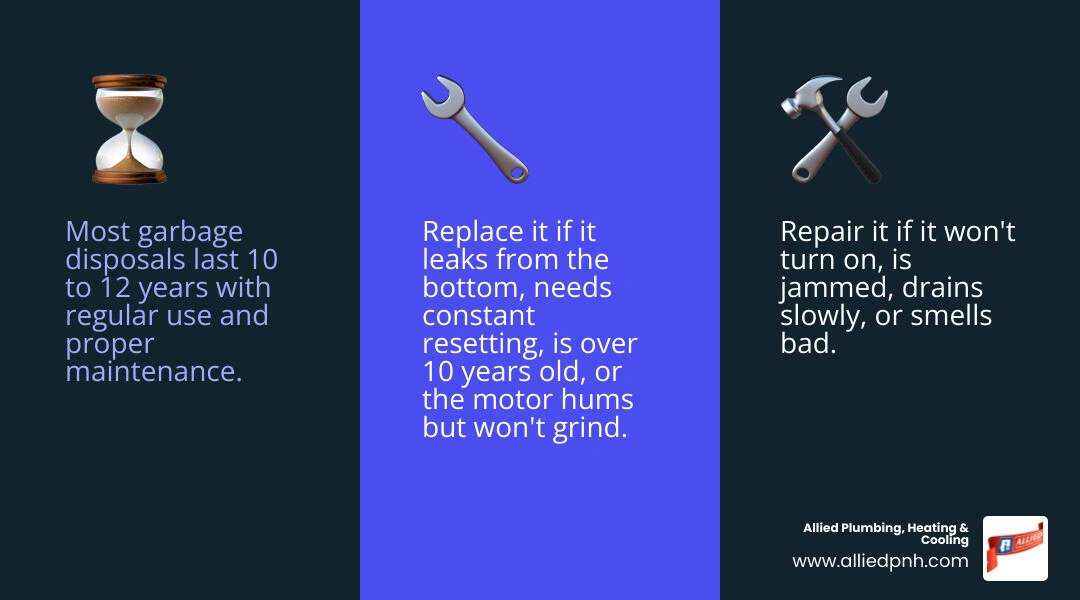
Most garbage disposals last 10 to 12 years with proper care. When yours starts acting up, the fix is sometimes as simple as pressing a button — but other times, pushing a struggling unit further only leads to bigger plumbing headaches down the road.
Imagine finishing a big family dinner, flipping the switch, and hearing nothing but a low, defeated hum. It happens to homeowners in Springfield all the time. The good news is that many disposal problems are easy to diagnose, and some are just as easy to fix.
This guide walks you through both.
Key Decisions: A Garbage Disposal Repair and Replacement Guide for Homeowners
When your kitchen sink stops performing its duties, it throws a major wrench into your daily routine. Suddenly, washing dishes becomes a chore wrapped in anxiety. Before you run out to buy a brand-new unit or spend hours under the cabinet with a flashlight, it helps to understand the lifespan, wear and tear, and environmental factors that affect your system right here in Springfield.
Generally, a standard kitchen garbage disposal has an expected lifespan of 10 to 12 years. If you have an entry-level model, it might start showing signs of fatigue around year 5 or 8. Premium models built with heavy-duty stainless steel components can easily stretch to 15 years with proper care.
However, local factors play a significant role. In Springfield, Rochester, and Chatham, our municipal water contains natural minerals that can lead to hard water scale buildup. Over time, these minerals deposit themselves inside the grinding chamber, on the impellers, and around the internal seals. This mineral scale can cause the motor bearings to seize or eat away at the watertight seals, leading to premature failure.
Additionally, everyday wear and tear takes its toll. If your household regularly treats the disposal like a secondary trash can, the motor and grinding components will wear down much faster. Dull impellers cannot grind food finely enough, which places extra strain on the motor and causes food waste to slip into your drain lines partially intact. This is precisely How Garbage Disposal Jams Turn Into Plumbing Problems, leading to deep clogs in your home’s main sewer lines.
To help you decide whether your unit is a candidate for a quick fix or if it is time to say goodbye, we have put together a quick-reference decision matrix:
• Loud, sad humming sound with no spinning — Likely Cause: Food jam or foreign object — Recommended Action: Repair: Clear the jam manually with a hex wrench.
• Completely dead (no sound at all) — Likely Cause: Tripped internal breaker or no power — Recommended Action: Repair: Press the red reset button or check the electrical panel.
• Water dripping from the bottom of the motor — Likely Cause: Failed internal seals or cracked housing — Recommended Action: Replace: Internal seals cannot be repaired safely; the unit must be replaced.
• Water leaking from the top sink flange — Likely Cause: Dried-out plumber's putty or loose bolts — Recommended Action: Repair: Re-seal the flange with fresh putty and tighten the mounting assembly.
• Frequent clogs and slow grinding — Likely Cause: Dull impellers or undersized motor — Recommended Action: Replace: Upgrading to a higher-horsepower unit with sharper impellers is best.
• Unit requires resetting multiple times a week — Likely Cause: Failing motor windings or electrical short — Recommended Action: Replace: The motor is at the end of its life and is drawing too much current.
• Persistent swamp-like odors — Likely Cause: Food buildup in the splash guard or chamber — Recommended Action: Repair: Deep clean with ice, rock salt, baking soda, and vinegar.
Troubleshooting Common Garbage Disposal Issues Safely
Working on a garbage disposal can feel intimidating because you are dealing with a high-powered appliance that combines electricity, water, and moving mechanical parts. However, as long as you follow strict safety protocols, troubleshooting is perfectly safe.
Your number one priority is protecting your hands and your home’s electrical system. Never put your fingers inside the garbage disposal. Even if you are 100% sure the switch is turned off, always use needle-nose pliers, tongs, or a wooden spoon to retrieve dropped objects or inspect the grinding chamber.
Before touching any plumbing lines or mechanical parts, you must cut the power. If your disposal plugs into an outlet under the sink, unplug it. If your unit is hardwired directly into a junction box, locate your home’s main service panel and switch off the circuit breaker dedicated to the kitchen sink area. Use a non-contact voltage tester to verify that no electrical current is running to the unit before you proceed.
Troubleshooting Tips from Our Garbage Disposal Repair and Replacement Guide for Homeowners
If your disposal won't turn on or simply hums when you flip the switch, don't panic. There are two highly effective troubleshooting steps you can perform right now.
First, let's address the completely dead unit. Garbage disposals feature an integrated circuit breaker designed to shut the motor off if it overheats or encounters a sudden jam. This keeps the motor from burning itself out.
1. Look under your sink at the very bottom of the disposal unit.
2. Locate the small, square, red button. This is the reset button.
3. If the button is popped out, the internal breaker has tripped. Gently press it back in until you hear a satisfying click.
4. If it won't stay in, wait about five to ten minutes for the motor to cool down completely, then try again.
5. Plug the unit back in or turn the breaker on, run a steady stream of cold water, and flip the wall switch.
If the unit still does not turn on, check your kitchen’s GFCI outlets and your main electrical panel to see if a circuit breaker has tripped. If the electrical connections are fine but the unit remains silent, you may need professional help with Plumbing Repair Springfield IL to diagnose a failed motor or wiring issue.
Now, what if you flip the switch and hear a low, vibrating hum, but the disposal isn't spinning? This means your motor is getting power, but the grinding plate is physically jammed by a hard piece of food, a stray utensil, or a build-up of mineral scale.
1. Turn off the wall switch and unplug the unit.
2. Grab the 1/4-inch hex wrench (often called an Allen wrench) that came with your disposal. If you lost it, any standard hex wrench from your toolbox will work.
3. Insert the wrench into the hexagonal hole located directly in the center of the bottom of the disposal.
4. Firmly rotate the wrench back and forth. If the plate is jammed, you will feel resistance. Force the wrench to turn clockwise and counterclockwise until you can rotate it a full 360 degrees freely. This manually breaks the jam inside the chamber.
5. Once the plate spins freely, look inside the drain with a flashlight. Use tongs or needle-nose pliers to pull out whatever caused the jam (such as a fruit pit, bone, or coin).
6. Plug the unit back in, restore power, press the red reset button if it popped out, run cold water, and test the unit.
How to Fix Clogs and Slow Drainage
If you flip the switch, the motor spins beautifully, but water begins backing up into your sink, you are dealing with a clog. Clogs typically occur in one of two places: inside the grinding chamber itself, or further down in the P-trap (the curved pipe under your sink).
When food waste is ground up without enough water, it forms a thick, pasty sludge that clings to the walls of your pipes. Over time, this sludge traps more debris, slowing down your drainage until the line stops up completely.
Here is how to clear a clogged or slow-running disposal safely:
• Never use chemical drain cleaners. Chemical cleaners are highly corrosive. They can permanently damage the plastic and rubber seals inside your disposal, corrode your metal pipes, and splash back up into your eyes or onto your skin.
• Inspect the splash guard. Sometimes, a slow drain is simply caused by a dirty, stiff rubber splash guard that isn't letting water flow through easily. Clean the underside of the black rubber guard with an old toothbrush and dish soap.
• Clear the P-trap manually. Place a shallow bucket under the curved waste pipe beneath your sink. Use channel-lock pliers to loosen the slip nuts securing the P-trap. Remove the trap and inspect it for compacted food waste, hair, or grease. Clean it out with a wire brush, rinse it in another sink, and reinstall it.
• Use a natural cleaning flush. Once the physical blockage is gone, deodorize and clear away residual grease by pouring half a cup of baking soda down the drain, followed by a cup of white vinegar. Let it fizz for 15 minutes, then flush the system with hot water.
To prevent these clogs from returning, read through our detailed Garbage Disposal Maintenance Tips to Prevent Breakdowns to establish healthy kitchen habits.
Step-by-Step DIY Replacement vs. Professional Installation
If you have determined that your disposal’s motor has given up the ghost or the housing is leaking water from the bottom, it is time for a replacement.
Many handy homeowners wonder if they can tackle this project as a DIY task. The answer depends on your comfort level with basic plumbing and electrical work. If you are doing a "same-mount" replacement — meaning you are replacing an old unit with a brand-new model from the same manufacturer — the process is incredibly straightforward. It usually takes between 30 to 90 minutes because you can keep the existing sink flange and mounting ring in place, saving you from having to scrape away old putty and reseal the drain.
However, if you are switching brands (for example, moving from a 3-bolt mounting system to an EZ Mount system), you will need to replace the entire mounting assembly. This requires working with plumber's putty, aligning tight metal snap rings, and modifying your existing plastic drain pipes to line up with the new unit’s discharge outlet. If your plumbing pipes are older or misaligned, or if your disposal is hardwired directly into the wall without a nearby outlet, hiring a professional plumber ensures the job is done safely, up to local building codes, and without the risk of water damage.
When to Choose Upgrades in This Garbage Disposal Repair and Replacement Guide for Homeowners
When shopping for a new unit, don't just buy the cheapest option on the shelf. Choosing the right horsepower (HP) and features for your household size will prevent future clogs and ensure your new investment lasts for over a decade.
Here is a quick breakdown of horsepower ratings:
• 1/3 Horsepower: Best for small apartments, single individuals, or kitchens with very light usage. These units have small grinding chambers and are prone to jamming if fed anything tougher than soft vegetables.
• 1/2 Horsepower: The standard entry-level size. It is suitable for small households of 1 to 2 people who cook occasionally.
• 3/4 Horsepower: The absolute "sweet spot" for average families of 3 to 4 people. These units grind food much finer, rarely jam, and usually feature advanced sound insulation so they don't sound like a jet engine taking off in your kitchen.
• 1 Horsepower or Higher: Excellent for large families, frequent home cooks, or those who want to process tougher food scraps. These heavy-duty motors can handle small bones, fibrous vegetables, and large volumes of waste easily.
You will also need to choose between continuous-feed and batch-feed models. Continuous-feed models are the most popular; they run continuously as long as the wall switch is turned on, allowing you to feed food waste in gradually. Batch-feed models only turn on when you insert a special drain stopper, making them exceptionally safe for households with curious children.
Lastly, look for models with stainless steel grinding components. Unlike galvanized steel, which can rust and corrode under the influence of hard water, stainless steel components resist corrosion and maintain their grinding efficiency for years. Learn more about selecting the perfect unit by reading our guide on Garbage Disposal Installation.
Step-by-Step Guide to Replacing Your Unit
If you are ready to tackle a DIY replacement, grab your tools (screwdrivers, channel-lock pliers, plumber's putty, a hammer, and a bucket) and follow these step-by-step instructions:
Step 1: Turn Off the Power
Always verify that the power is completely disconnected. Unplug the unit or switch off the circuit breaker. Use a voltage tester to ensure the wires are dead.
Step 2: Disconnect the Plumbing Lines
Place a bucket under the disposal. Use pliers to disconnect the waste discharge pipe and the P-trap. If you have a dishwasher, disconnect the dishwasher drain hose from the disposal's inlet pipe.
Step 3: Support and Remove the Old Unit
Support the heavy disposal with one hand or place a car jack or block of wood beneath it to prevent it from dropping. Insert a screwdriver or the hex wrench into one of the mounting ears on the mounting ring. Turn the ring counterclockwise to release the disposal from the mounting assembly, then carefully lower the unit down.
Step 4: Remove the Old Mounting Ring (If Switching Brands)
If you are changing brands, loosen the three screws on the old mounting assembly. Use a flathead screwdriver to pry off the metal snap ring, then pull the mounting assembly off the sink flange. Push the old sink flange up through the drain hole from below, and scrape away all old plumber's putty from the sink opening.
Step 5: Install the New Mounting Assembly
Roll a piece of fresh plumber's putty into a rope about 3/8-inch thick. Wrap it around the underside of the new sink flange. Press the flange firmly down into the sink drain hole. From beneath the sink, slide the fiber gasket, backup ring, and mounting ring onto the flange. Hold them in place while sliding the metal snap ring up until it snaps into the groove on the flange. Evenly tighten the three mounting screws until the assembly is tight against the sink. Wipe away any excess putty that squeezes out into the sink basin.
Step 6: Knock Out the Dishwasher Plug (Crucial Step!)
If you have a dishwasher connected to your disposal, do not skip this step! Inside the disposal’s upper inlet tube, there is a plastic knockout plug.
1. Lay the disposal on its side.
2. Place a flathead screwdriver or punch against the plastic plug inside the tube.
3. Tap the screwdriver firmly with a hammer to break the plug loose.
4. Reach inside the grinding chamber and remove the loose plastic piece. If you leave this plug inside, your dishwasher will not drain, leading to a flooded kitchen floor during its next cycle.
Step 7: Wire the New Disposal
If your new unit did not come with a pre-installed power cord, you will need to transfer the cord from your old unit or wire a new one. Remove the electrical cover plate on the bottom of the new disposal. Feed the cord through the strain relief clamp, connect the white wire to white, black to black, and the green (or bare copper) ground wire to the green ground screw. Secure the connections with wire nuts and reinstall the cover plate.
Step 8: Mount the New Disposal
Align the three mounting tabs on the disposal with the ramps on the mounting ring. Lift the heavy disposal into place, engaging the tabs. Turn the mounting ring clockwise with your screwdriver or wrench until the disposal is locked securely in place.
Step 9: Reconnect the Plumbing and Test
Reattach the waste discharge pipe and the dishwasher drain hose (secured with a stainless steel hose clamp). Reconnect the P-trap.
Step 10: Run the Leak Test
Turn on the faucet and run cold water into the sink. Fill the sink basin with a few inches of water, then pull the plug to release it all at once. This creates a high-pressure flow that will immediately reveal any small leaks around the flange or plumbing connections. If everything is dry, turn the power back on and test the motor.
Frequently Asked Questions about Garbage Disposals
We regularly help homeowners keep their kitchens running smoothly. Here are answers to some of the most common questions we receive from residents in Rochester and Chatham.
How long does a typical garbage disposal last in Rochester?
In Rochester, IL, a typical garbage disposal lasts between 10 and 12 years. However, because our local water supply contains natural mineral content, mineral scale can build up inside the grinding chamber over time. This hard water scale can cause the internal seals to dry out and crack, or cause the motor bearings to seize up prematurely.
To maximize your disposal's lifespan, flush it once a month with a handful of ice cubes and half a cup of rock salt. The ice and salt scrub away mineral deposits and food particles from the rotating impellers without dulling them.
What should I avoid putting down my garbage disposal?
A garbage disposal is not a trash can. To prevent stubborn clogs and motor strain, keep these items out of your kitchen sink:
• Fats, Oils, and Grease (FOG): Warm grease looks liquid when you pour it down the drain, but it quickly cools and solidifies inside your pipes, creating a thick barrier that traps all other food waste.
• Fibrous Vegetables: Celery, asparagus, corn husks, and onion skins have tough, stringy fibers that can wrap around the rotating impellers and seize the motor.
• Starchy Foods (Pasta, Rice, Potato Peels): These foods expand when they absorb water. They turn into a thick, sticky paste inside your pipes that is incredibly difficult to clear.
• Coffee Grounds and Eggshells: Coffee grounds do not float; they settle in the low points of your plumbing pipes, forming a dense silt. The thin membrane inside eggshells can wrap around the grinding ring, while the shells themselves act like sand, settling in your P-trap.
Do I need a plumber or an electrician to replace my disposal in Chatham?
In Chatham, IL, a licensed plumber is usually your best choice for a garbage disposal replacement. Plumbers are fully trained to handle both the watertight plumbing connections and the basic electrical wiring required to connect the disposal to an existing outlet.
However, if your old disposal was hardwired directly into the wall and you want to convert it to a standard plug-in outlet, or if there is no electrical source under your sink, you will need an electrician to run a new GFCI-protected circuit first. Once the electrical outlet is in place, our team can handle the installation seamlessly.
Conclusion
A properly functioning garbage disposal is the unsung hero of a clean, efficient kitchen. Whether you are dealing with a minor jam that needs a quick turn of a hex wrench, or a failed motor that requires a complete system upgrade, taking care of your plumbing system prevents minor issues from turning into major household emergencies.
If you are facing a stubborn leak, a seized motor, or simply want the peace of mind that comes with a professional installation, we are here to help. At Allied Plumbing, Heating & Cooling, we have been serving our neighbors in Springfield, Rochester, and Chatham since 1977. As a three-generation family business, we pride ourselves on delivering reliable, honest, and high-quality plumbing services.
Don't let a broken disposal disrupt your home's comfort. Contact us today for professional Plumbing Springfield IL solutions, or schedule your service directly through our Plumbing Services page. We are ready 24/7 to keep your kitchen running smoothly!