How Many Mini Split Heads Do I Need for My Springfield Home?
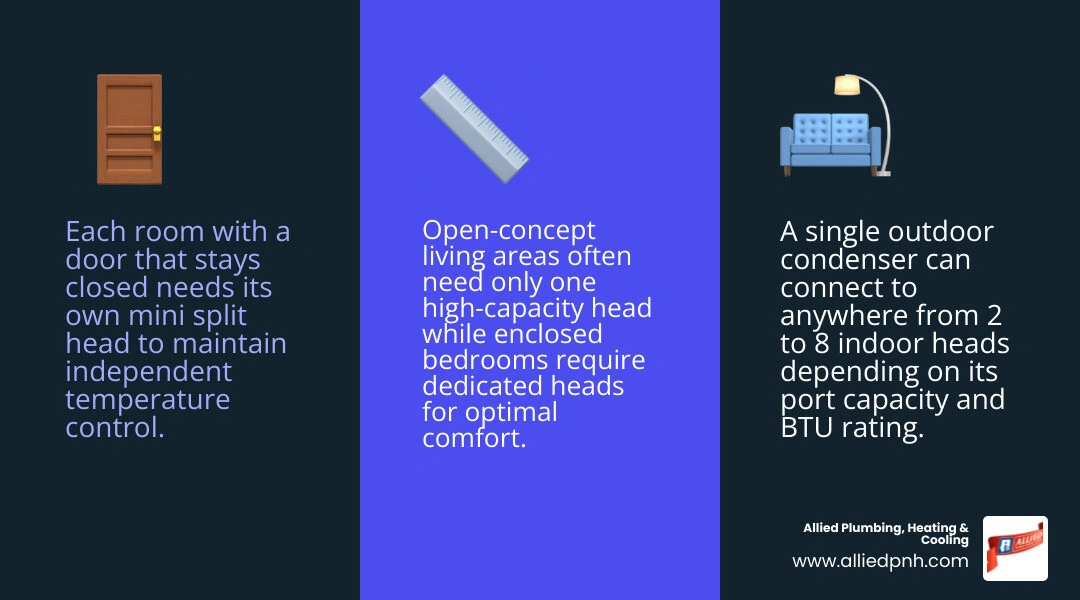
If you're wondering how many mini split heads do I need, here's the short answer: most homes need one indoor head per room that has a door that stays closed. Open-concept spaces can often share a single head, and bathrooms typically don't need one at all.
Quick Reference: Mini Split Heads by Home Size
• Under 600 sq ft — Typical Head Count: 1 head
• 600–1,200 sq ft — Typical Head Count: 2–3 heads
• 1,200–2,000 sq ft — Typical Head Count: 3–4 heads
• 2,000–3,000 sq ft — Typical Head Count: 4–5 heads
• 3,000+ sq ft — Typical Head Count: 5–8 heads
These are starting points. Your actual number depends on your floor plan, insulation, ceiling height, and how you use each room.
One of the most common questions Springfield homeowners ask before going ductless is figuring out the right number of indoor air handlers for their home — and it's a smart question to ask early. Get it right and you'll have consistent, energy-efficient comfort in every room. Get it wrong and you could end up with stuffy bedrooms, a freezing hallway, or a system that short-cycles and wears out faster than it should.
A single outdoor condenser can support anywhere from 2 to 8 indoor heads depending on the model, so there's a lot of flexibility in how you design your system. The key is matching the number and size of heads to your home's actual layout and comfort needs — not just its square footage.
How many mini split heads do i need word roundup:
• best rooms for a mini split system
• ductless mini split systems explained
Key Factors Determining How Many Mini Split Heads Do I Need
Determining the perfect head count for your home is as much an art as it is a science. While square footage gives us a baseline, your home’s architectural personality dictates the final configuration.
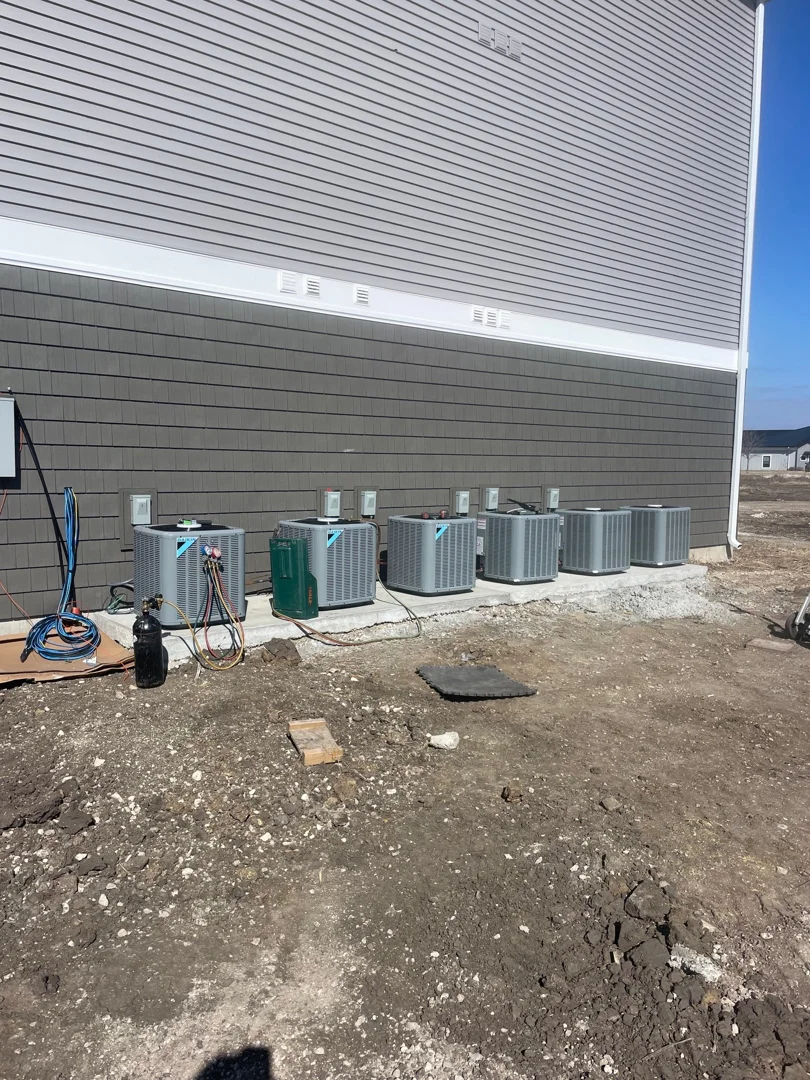
When we evaluate a home in Springfield, Rochester, or Chatham, we look at several environmental and structural variables. A standard mini-split head delivers anywhere from 6,000 to 36,000 BTUs of heating or cooling capacity. To figure out how many of these units you need, we must look beyond the raw numbers.
To understand the core components of these systems, check out our guide on Ductless Mini Split Systems Explained. Here are the primary factors we analyze when designing your layout:
• Insulation Quality and Home Age: Older historic homes in Rochester or Springfield often have plaster walls and original windows. These draftier spaces require more targeted zones—and sometimes slightly larger BTU capacities—than a modern, tightly sealed home in Chatham.
• Ceiling Height: Standard sizing charts assume 8-foot ceilings. If your living room features vaulted ceilings, we add 10% to the cooling capacity for every two feet of extra height to account for the extra volume of air.
• Sun Exposure and Windows: South-facing rooms with large windows act like greenhouses in the summer. These spaces often need a dedicated indoor head to combat the solar heat gain, even if the room's square footage is relatively small.
• Room Usage and Heat Sources: Kitchens require special attention. Between the oven, stove, refrigerator, and dishwasher, kitchens generate significant internal heat. We typically add 4,000 BTUs to the calculation for any zone that includes a kitchen.
The Door Rule and Room Layout
The single most important rule of thumb in the ductless world is the "Door Rule." Simply put, air conditioning cannot travel through solid walls, and it struggles to move efficiently through standard doorways.
If you have a room with a door that stays closed most of the time—such as a master bedroom, a home office, or a nursery—it needs its own dedicated mini-split head. Trying to cool three separate bedrooms with one large indoor head placed in a central hallway is a classic mistake. You will end up with a freezing hallway and three stuffy, uncomfortable bedrooms.
For a deeper dive into finding the perfect spots for your indoor units, read our guide on Where to Place Your Mini Split Units Springfield.
Floor Count and Heat Stratification
Multi-story homes face the natural challenge of heat stratification—the physical law that warm air rises and cool air sinks. During humid Illinois summers, the second floor of a Rochester home will always feel significantly warmer than the main level.
To solve this uneven comfort, you must plan your head count by floor. We recommend at least one indoor head per level of the home. This allows you to set different temperatures for each floor, ensuring the upstairs bedrooms stay cool at night without freezing out the main-floor living room. To learn more about how zoning solves this issue, read about how to Solve Uneven Cooling with Ductless AC.
Sizing Your System: BTUs and Zone Configurations
Once we establish which areas of your home need dedicated comfort control, we determine the heating and cooling capacity (measured in British Thermal Units, or BTUs) required for each zone.
As a general rule of thumb, it takes about 20 to 25 BTUs to cool one square foot of space in our climate. For heating during chilly Illinois winters, that requirement can rise to 30 to 40 BTUs per square foot.
• 6,000 to 9,000 BTU heads typically cover small bedrooms or home offices (150 to 350 sq. ft.).
• 12,000 BTU heads are perfect for medium-sized master suites or dining rooms (500 to 600 sq. ft.).
• 18,000 to 24,000 BTU heads are designed for larger family rooms, basements, or open-concept living spaces (650 to 1,100 sq. ft.).
Properly sizing each head is critical. If a head is oversized, it will cool the room too quickly and shut off before it has a chance to dehumidify the air, leaving the room feeling cold and clammy. Undersizing, on the other hand, means the unit will run constantly, wasting energy and failing to keep up on hot summer days.
For help choosing the right capacity, see our guide on Choosing a Ductless AC System for Your Space.
How Many Mini Split Heads Do I Need for Open-Concept Spaces?
If you have a modern, open-concept floor plan in Chatham where the living room, dining area, and kitchen flow seamlessly into one another, you do not need a head for each individual "area." Because there are no doors or walls blocking the airflow, a single, strategically placed high-capacity head (such as an 18,000 or 24,000 BTU unit) can easily condition the entire open space.
The key is placing the head where the air can circulate naturally. For instance, mounting the indoor unit on a central wall where it can blow down the longest length of the open room ensures even temperatures throughout the entire space.
How Many Mini Split Heads Do I Need for Enclosed Bedrooms?
Enclosed bedrooms are the absolute best candidates for dedicated mini-split heads. Everyone has a different "temperature personality." You might love sleeping in a crisp, 65-degree room, while your teenager prefers a cozy 72 degrees.
By installing a small, dedicated head in each bedroom, everyone gets personalized comfort. Because each head has its own thermostat, you can turn off the units in empty guest rooms or home offices during the day, drastically reducing your energy consumption. To learn more about which spaces benefit most from this setup, read our article on the Best Rooms for a Mini Split System.
Reducing Head Count with Slim-Duoted Systems
If you want the zoning benefits of a mini-split but dislike the idea of having multiple wall-mounted units in every room, there is an elegant alternative: slim-ducted mini-split systems.
A slim-ducted unit (or concealed utility unit) is hidden away in an attic, crawl space, or drop ceiling. Instead of hanging on the wall, it connects to short, localized runs of ductwork that terminate in subtle grilles in your ceiling or floor.
A single slim-ducted indoor unit can easily heat and cool two or three adjacent rooms—like a cluster of upstairs bedrooms—using a fraction of the space. This allows you to drastically reduce your total head count while keeping the equipment completely out of sight.
When comparing your options, it helps to understand the structural differences between traditional ducted systems and zoning systems. You can read more in our Central AC vs Ductless Mini Split Comparison. Additionally, you can learn about the long-term value of these systems by viewing our Advantages of Mini Split Systems Installed by Us and exploring our Mini Split vs Central AC Cost Comparison.
Frequently Asked Questions About Mini Split Head Count
Planning a ductless transition brings up plenty of practical questions. Here are the answers to the questions we hear most often from homeowners in the Springfield area.
Do I need a mini-split head in every room?
No, you do not need a head in every single room. You only need a head in the rooms or "zones" where you want independent temperature control.
Bathrooms, walk-in closets, and pantries almost never need their own mini-split heads. The air circulating from adjacent rooms is more than enough to keep these smaller spaces comfortable. In fact, we advise against putting mini-split heads in bathrooms because the high humidity from showers can interfere with the unit's sensitive electronic sensors.
Can one outdoor condenser support multiple indoor heads?
Yes! This is called a multi-zone system. A single high-capacity outdoor condenser can support up to 8 indoor heads, depending on the manufacturer and model.
What makes this setup incredibly efficient is "load diversity." Because your family moves throughout the house during the day, you rarely run every single indoor head at maximum capacity at the same time. Modern smart condensers can shift heating or cooling capacity to the rooms that need it most, allowing the total BTU capacity of your indoor heads to exceed the outdoor unit's capacity by up to 130%.
Can I add more indoor heads to my system later?
You can add more heads later, but only if your outdoor condenser was designed for it from day one.
Outdoor units have a fixed number of refrigerant ports (usually between 2 and 5 for residential systems, up to 8 for specialty units). If you install a 3-zone outdoor unit and connect 3 indoor heads to it, you cannot add a 4th head later without replacing the entire outdoor condenser. If you plan to finish a basement or add an addition in a few years, let us know so we can install a condenser with an extra, unused port for future expansion.
Conclusion
Determining how many mini split heads do i need doesn't have to be a guessing game. By looking at your home's layout, keeping the "Door Rule" in mind, and exploring options like slim-ducted units, you can design a system that fits your lifestyle perfectly.
At Allied Plumbing, Heating & Cooling, we’ve been helping families throughout Springfield, Rochester, and Chatham stay comfortable since 1977. As a third-generation, family-owned business, we take pride in our extensive experience and dedication to customer satisfaction. We stand behind our work with the Daikin Comfort Promise and industry-leading 12-year warranties, giving you total peace of mind.
Ready to stop the thermostat wars and design the perfect zoned comfort system for your home? Schedule a professional consultation for your Springfield home with our friendly team today!